The Source / A field guide to feeling better
Upper & Mid Back
The middle of the back connects the rib cage, shoulder blades and spine. Pain here needs context, not a posture verdict.
Can you point to it?
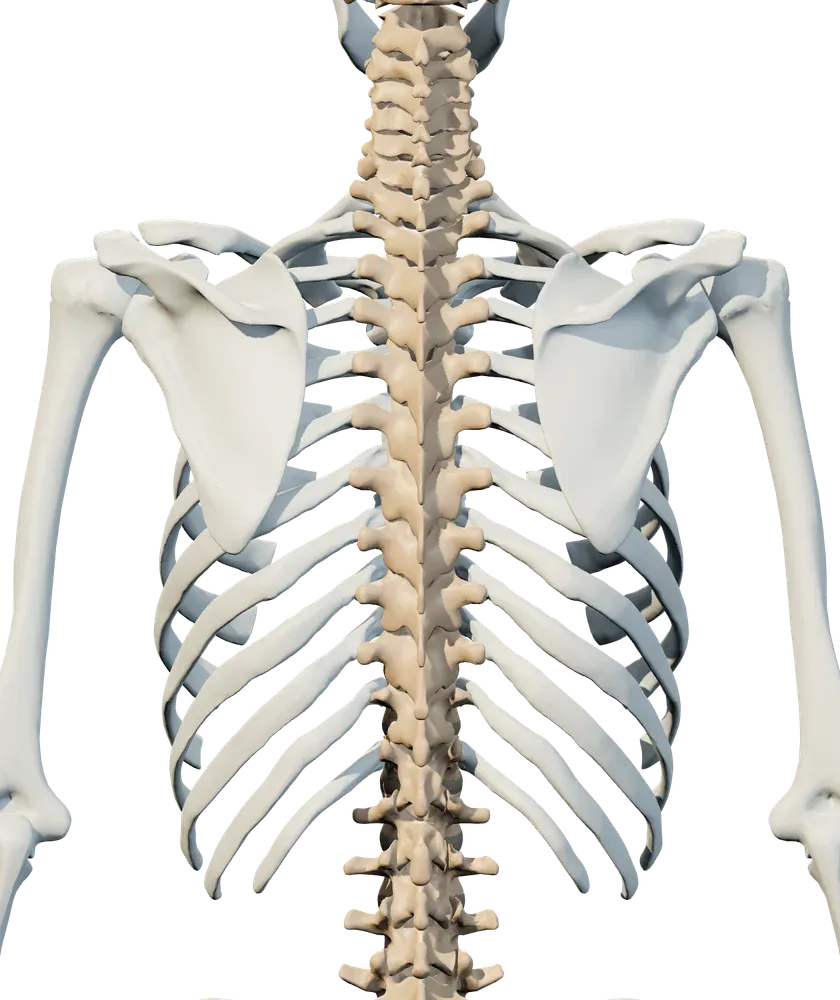
Select a label to explore its side of the body
Choose the closest area.
Select a point on the close-up, or choose below. You’ll find possible explanations, questions to bring to a visit, and the evidence behind the discussion.
Put the symptoms in context
An assessment considers movement and loading as well as injury, illness and symptoms outside the back. Research on low-back pain does not automatically apply to thoracic pain.
Follow the question
Explore upper & mid back
These guides describe possibilities, not a diagnosis. Each explains what to ask, where the evidence applies and when another kind of care is needed.
- Condition guide
Back pain
Common back-pain patterns, warning signs and how to judge progress in everyday life.
Understand this condition - Condition guide
Scoliosis
Spinal curvature, monitoring and the difference between managing symptoms and changing a curve.
Understand this condition - Condition guide
Work-related pain
How job demands, an injury history and a practical return-to-activity plan fit together.
Understand this condition
A location is only the beginning
Use the back-pain guide for general assessment questions and warning signs. For a diagnosed spinal curve, the scoliosis guide explains monitoring, symptoms and specialist care. If work tasks are part of the picture, the work-injury guide can help you prepare a practical history.
Note any injury, the timing of the pain and whether breathing or symptoms outside the back are involved. Do not assume that discomfort between the shoulder blades is simply a posture problem.
Do not borrow evidence from another region
Much back-pain research concerns the lower back. Its findings should not automatically be applied to the thoracic spine. The study below addresses bracing for selected adolescents with scoliosis; it is included for that guide, not as support for treating every middle-back ache.
Follow the evidence
Research, with context.
Published sources behind the discussion. Read the findings alongside the limits; a study is not a diagnosis or a promise of a result.
Effects of bracing in adolescents with idiopathic scoliosis
242 adolescents with the usual indications for bracing, in randomized and patient-preference groups.
What it foundIn the randomized group, 75% assigned bracing versus 42% assigned observation reached skeletal maturity without progression to a curve of at least 50 degrees.
What it cannot tell usThis supports appropriate orthopedic assessment and bracing in selected adolescents. It provides no evidence that adjustments reverse scoliosis.
Publication details & citation
Weinstein et al. Effects of bracing in adolescents with idiopathic scoliosis. New England Journal of Medicine. 2013. DOI: 10.1056/NEJMoa1307337.
Read the publication record
Read our editorial policy for how sources and clinical review are identified.