The Source / A field guide to feeling better
Neck
The neck moves your head and carries nerves toward the shoulder, arm and hand. Symptoms can travel.
Can you point to it?
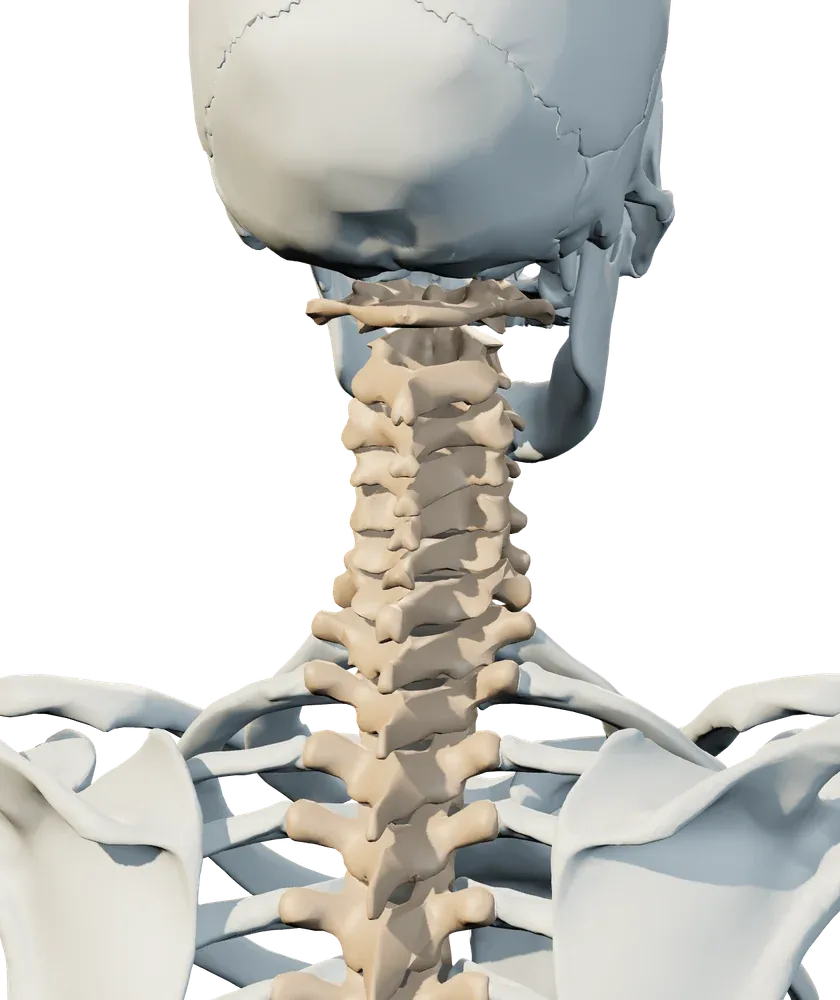
Choose the closest area.
Select a point on the close-up, or choose below. You’ll find possible explanations, questions to bring to a visit, and the evidence behind the discussion.
Put the symptoms in context
Location is a useful starting point, but it does not settle the diagnosis. A clinician considers movement, strength, sensation and any injury history, as well as whether symptoms need medical investigation.
Follow the question
Explore neck
These guides describe possibilities, not a diagnosis. Each explains what to ask, where the evidence applies and when another kind of care is needed.
- Condition guide
Neck pain
Stiffness, referred pain and nerve symptoms: understand the questions an examination should answer.
Understand this condition - Condition guide
Whiplash
What to watch for after an acceleration injury and how recovery is assessed.
Understand this condition - Condition guide
Headaches & migraines
Different headache patterns, what an assessment can clarify, and symptoms that need urgent care.
Understand this condition
Follow symptoms that travel
Pain that stays around the neck and tingling that reaches the hand are different starting points. The neck-pain guide explains assessment and warning signs. After a collision, begin with whiplash, including when an injury needs medical evaluation.
Record whether symptoms change with movement, sleep or work, and whether strength or sensation has changed. Bring previous reports if you have them; an image is part of an assessment rather than a diagnosis by itself.
Ask what progress should look like
Turning to check traffic, sleeping more comfortably or returning to a work task can be meaningful goals. Ask how the proposed treatment relates to your findings and when the plan will be reviewed. The trial below compares options for a particular group with recent neck pain; it does not settle the treatment of every neck disorder.
Follow the evidence
Research, with context.
Published sources behind the discussion. Read the findings alongside the limits; a study is not a diagnosis or a promise of a result.
Spinal manipulation, medication, or home exercise with advice for acute and subacute neck pain: a randomized trial
272 adults with nonspecific neck pain lasting 2–12 weeks.
What it foundManipulation performed better than medication at several follow-ups, but there was no important pain difference between manipulation and home exercise with advice.
What it cannot tell usTreatment was unblinded. The study does not cover every cause of neck pain, traumatic instability or an unexplained neurological problem.
Publication details & citation
Bronfort et al. Spinal manipulation, medication, or home exercise with advice for acute and subacute neck pain: a randomized trial. Annals of Internal Medicine. 2012. DOI: 10.7326/0003-4819-156-1-201201030-00002.
Read the publication record
Read our editorial policy for how sources and clinical review are identified.