03 / Understand the area
Base of the neck
The transition from neck to shoulders often gets called tension. Its timing and effect on movement tell a more useful story.
An educational guide for either side of the body. Location alone cannot tell us the cause of a symptom.
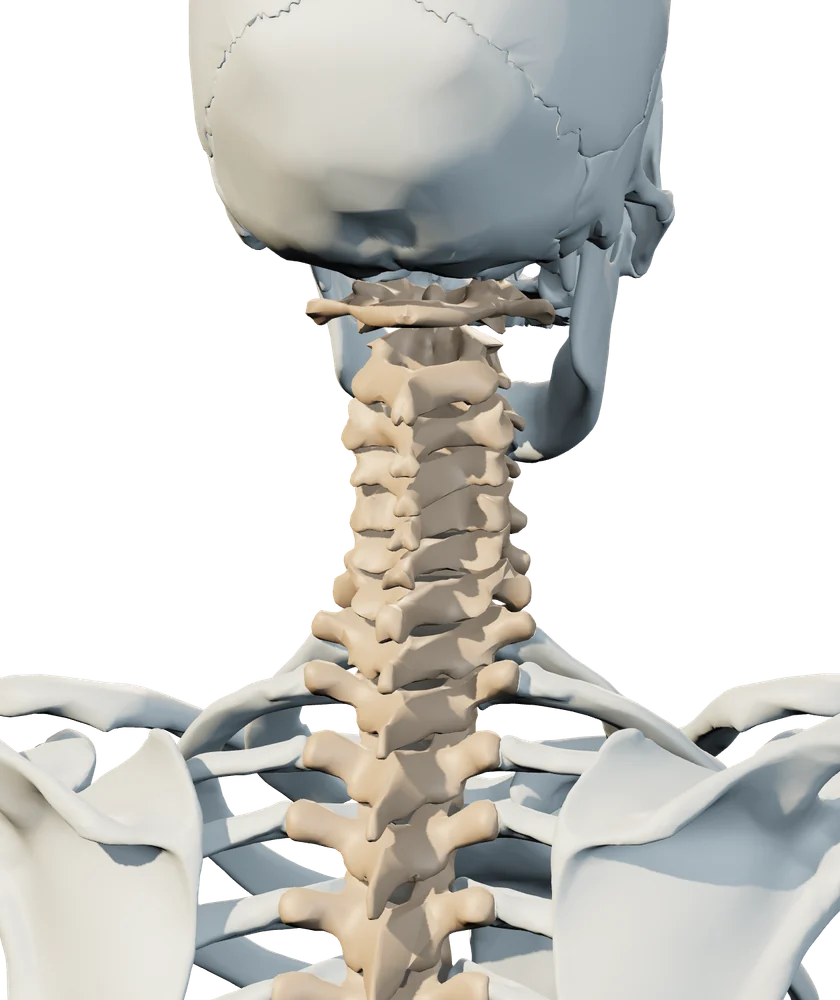
A useful starting point
What this area can tell you.
Desk work, driving and lifting offer different clues, but the activity present when pain appears is not automatically its cause. Note how long a position stays comfortable and what happens when you change tasks. After a collision, describe the injury and how symptoms developed instead of assuming ordinary muscle soreness. An examination may include the neck, shoulders and arms, especially when symptoms travel beyond the base of the neck.
Notice the pattern
Three questions to bring with you.
You don’t need to work out a diagnosis before a visit. These details can help you describe what you’re experiencing.
- Does the discomfort build during driving, desk work or lifting, and how quickly does it settle?
- Can you turn your head comfortably enough for ordinary tasks such as checking traffic?
- Did symptoms follow a collision, and have headache, arm symptoms or sleep difficulty changed since then?
When to get help sooner
Severe neck pain after a significant collision or fall needs urgent medical assessment. New weakness, difficulty walking or loss of bladder or bowel control needs emergency care.
Follow the connection
Possible explanations. Better questions.
These guides explore conditions or patterns that may overlap with this area. They are starting points for a conversation, not a list of diagnoses that can be confirmed from a body map.
Neck pain
Stiffness, referred pain and nerve symptoms: understand the questions an examination should answer.
Read the guide Condition guideWhiplash
What to watch for after an acceleration injury and how recovery is assessed.
Read the guide Condition guideWork-related pain
How job demands, an injury history and a practical return-to-activity plan fit together.
Read the guideRead the result with its limits
How the research fits this area.
The neck study and chronic whiplash trial examined different patient groups. Neither found that more intensive care was automatically better than the exercise or advice comparison used.
How we select and explain sources ↗Follow the evidence
Research, with context.
Published sources behind the discussion. Read the findings alongside the limits; a study is not a diagnosis or a promise of a result.
Spinal manipulation, medication, or home exercise with advice for acute and subacute neck pain: a randomized trial
272 adults with nonspecific neck pain lasting 2–12 weeks.
What it foundManipulation performed better than medication at several follow-ups, but there was no important pain difference between manipulation and home exercise with advice.
What it cannot tell usTreatment was unblinded. The study does not cover every cause of neck pain, traumatic instability or an unexplained neurological problem.
Publication details & citation
Bronfort et al. Spinal manipulation, medication, or home exercise with advice for acute and subacute neck pain: a randomized trial. Annals of Internal Medicine. 2012. DOI: 10.7326/0003-4819-156-1-201201030-00002.
Read the publication recordComprehensive physiotherapy exercise programme or advice for chronic whiplash (PROMISE): a pragmatic randomised controlled trial
172 people with grade I–II whiplash lasting more than three months.
What it foundAn intensive exercise program did not improve pain more than an advice session with telephone support at the measured follow-ups.
What it cannot tell usThis compares two specific approaches to chronic whiplash. It does not show that all exercise is ineffective or address every acute injury.
Publication details & citation
Michaleff et al. Comprehensive physiotherapy exercise programme or advice for chronic whiplash (PROMISE): a pragmatic randomised controlled trial. The Lancet. 2014. DOI: 10.1016/S0140-6736(14)60457-8.
Read the publication record
Read our editorial policy for how sources and clinical review are identified.
Your next step
Bring your questions.
We’ll start there.
An assessment can help clarify the pattern, discuss suitable care, and identify when another clinician should be involved.
Anatomy: BodyParts3D, © DBCLS, CC BY 4.0. Model & rendering credits. Return to the full body explorer.