03 / Understand the area
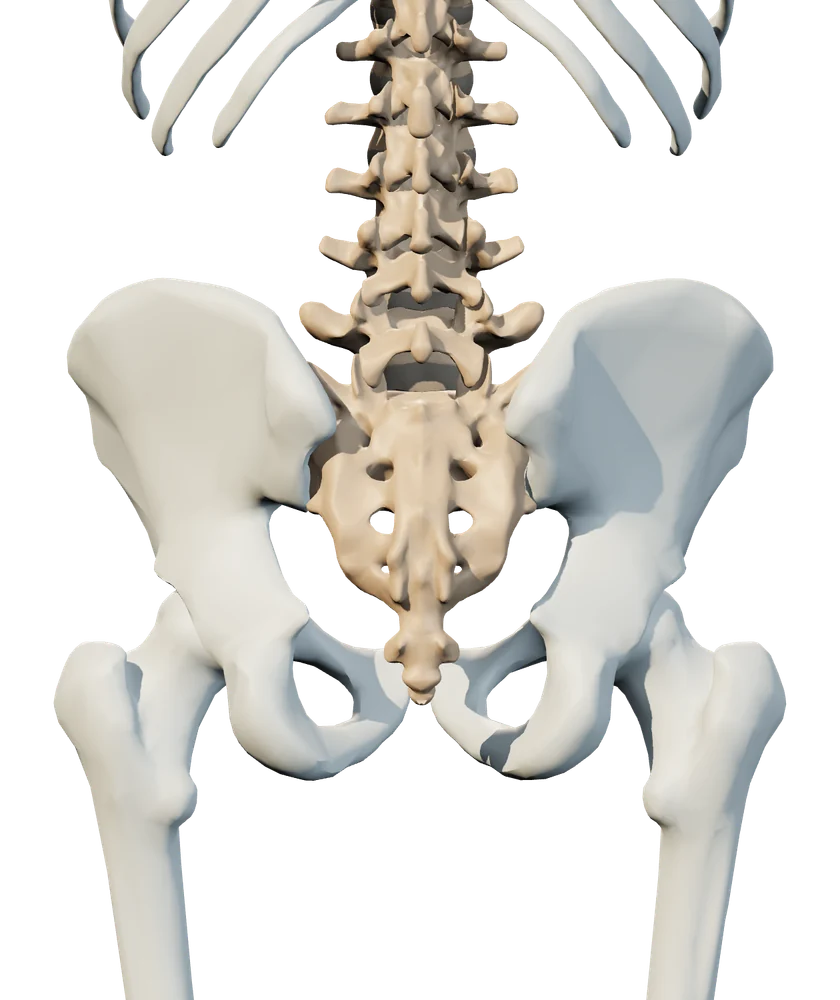
Buttock & back of the pelvis
The buttock sits at the meeting point of the hip, pelvis and lower back. Several symptom patterns can overlap here.
An educational guide for either side of the body. Location alone cannot tell us the cause of a symptom.
A useful starting point
What this area can tell you.
Pain that stays in one buttock is different from pain accompanied by tingling down the leg, although neither settles the cause. Describe sitting tolerance, walking and whether symptoms extend below the knee. An assessment may consider the hip, lower back and sacroiliac region. A sensation that the pelvis is uneven does not diagnose sacroiliac pain. If that joint is being considered, ask which findings support the explanation and what would prompt the clinician to reconsider it.
Notice the pattern
Three questions to bring with you.
You don’t need to work out a diagnosis before a visit. These details can help you describe what you’re experiencing.
- Does pain stay in the buttock or travel below the knee with tingling or numbness?
- Is sitting, walking or rising from a chair the most difficult activity?
- Did symptoms follow a fall, a change in activity or a period of back pain?
When to get help sooner
Buttock or leg pain with new bladder or bowel changes or numbness around the genitals or anus needs emergency care. Progressive leg weakness or severe pain after a fall needs urgent assessment.
Follow the connection
Possible explanations. Better questions.
These guides explore conditions or patterns that may overlap with this area. They are starting points for a conversation, not a list of diagnoses that can be confirmed from a body map.
Hip pain
Groin, outer-hip and buttock pain can point to different structures and different next steps.
Read the guide Condition guideSciatica
Leg pain related to nerve irritation, what scans can and cannot tell you, and when to seek help.
Read the guide Condition guideBack pain
Common back-pain patterns, warning signs and how to judge progress in everyday life.
Read the guideRead the result with its limits
How the research fits this area.
The small SI-joint study evaluated combinations of clinical tests against diagnostic injections; it did not test alignment correction. Sciatica research applies when assessment identifies a nerve-related leg-pain pattern, not isolated buttock pain.
How we select and explain sources ↗Follow the evidence
Research, with context.
Published sources behind the discussion. Read the findings alongside the limits; a study is not a diagnosis or a promise of a result.
Diagnosis of sacroiliac joint pain: validity of individual provocation tests and composites of tests
48 patients assessed with clinical provocation tests and intra-articular anesthetic injections.
What it foundA cluster of pain-provoking tests was more useful than relying on a single finding to identify SI-joint pain in this sample.
What it cannot tell usThe sample was small and selected. This is diagnostic research, not proof of pelvic misalignment or the effectiveness of a treatment.
Publication details & citation
Laslett et al. Diagnosis of sacroiliac joint pain: validity of individual provocation tests and composites of tests. Manual Therapy. 2005. DOI: 10.1016/j.math.2005.01.003.
Read the publication recordSurgery versus prolonged conservative treatment for sciatica
283 patients with severe sciatica lasting 6–12 weeks, assigned early surgery or prolonged conservative care with surgery if needed.
What it foundEarly surgery provided faster relief and recovery, while one-year outcomes were similar.
What it cannot tell usAbout 39% initially assigned conservative care had surgery. This was not a chiropractic trial and does not show that treatment shrinks discs or guarantees avoiding surgery.
Publication details & citation
Peul et al. Surgery versus prolonged conservative treatment for sciatica. New England Journal of Medicine. 2007. DOI: 10.1056/NEJMoa064039.
Read the publication record
Read our editorial policy for how sources and clinical review are identified.
Your next step
Bring your questions.
We’ll start there.
An assessment can help clarify the pattern, discuss suitable care, and identify when another clinician should be involved.
Anatomy: BodyParts3D, © DBCLS, CC BY 4.0. Model & rendering credits. Return to the full body explorer.