03 / Understand the area
Back of the head
An ache where the head meets the neck raises useful questions about both headache symptoms and neck movement.
An educational guide for either side of the body. Location alone cannot tell us the cause of a symptom.
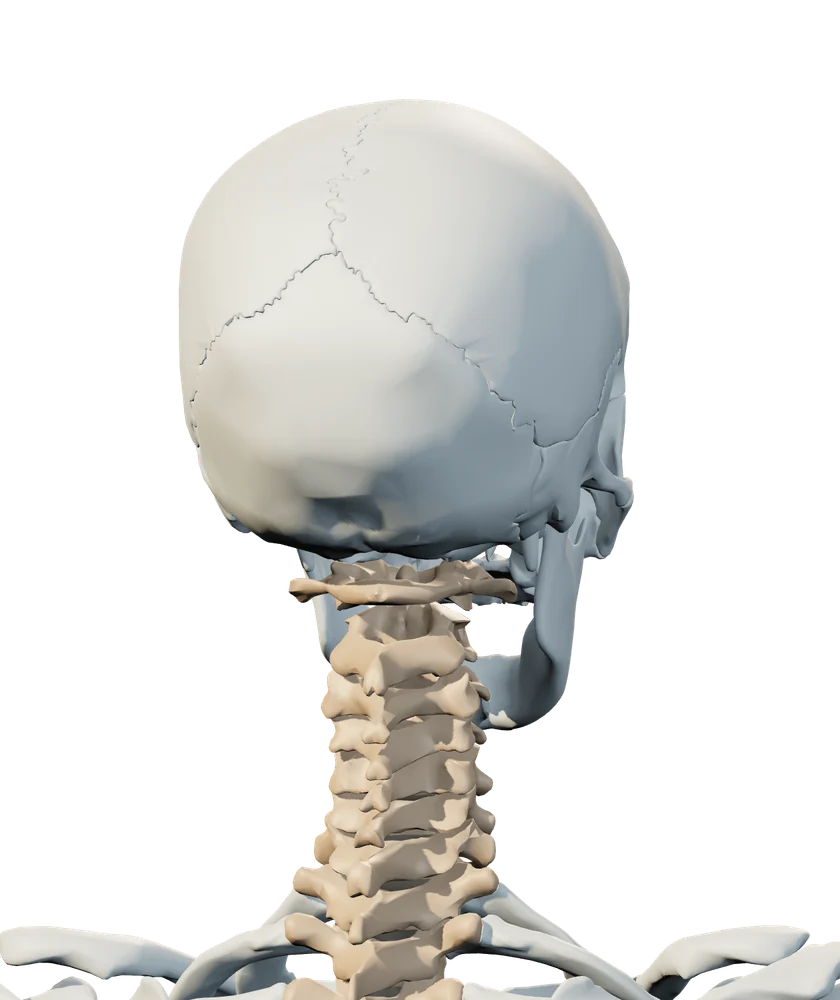
A useful starting point
What this area can tell you.
Pain at the back of the head is sometimes accompanied by a stiff neck, but the combination does not prove the neck is causing the headache. A clinician needs to understand the onset, the headache pattern and any neurological symptoms before considering a musculoskeletal explanation. Note whether ordinary head turns reproduce familiar symptoms and whether the pain spreads toward the temple or eye. Avoid repeatedly forcing a painful movement to test the connection yourself.
Notice the pattern
Three questions to bring with you.
You don’t need to work out a diagnosis before a visit. These details can help you describe what you’re experiencing.
- Did the pain develop gradually, follow an injury or start suddenly at full intensity?
- Do normal head turns change the familiar pain, or does the headache occur independently?
- Does the pain spread toward an eye or temple, and are dizziness or visual changes present?
When to get help sooner
A sudden, unusually severe headache, new weakness or speech difficulty, or headache with fever and a stiff neck needs emergency care. A new headache after a significant head or neck injury needs prompt medical assessment.
Follow the connection
Possible explanations. Better questions.
These guides explore conditions or patterns that may overlap with this area. They are starting points for a conversation, not a list of diagnoses that can be confirmed from a body map.
Read the result with its limits
How the research fits this area.
The trial studied people assessed as having cervicogenic headache. Its findings for exercise and manual therapy cannot be applied to every headache at the back of the head.
How we select and explain sources ↗Follow the evidence
Research, with context.
Published sources behind the discussion. Read the findings alongside the limits; a study is not a diagnosis or a promise of a result.
A randomized controlled trial of exercise and manipulative therapy for cervicogenic headache
200 people with cervicogenic headache, assigned to manipulation, specific exercise, both, or a control group.
What it foundManipulative therapy and exercise each reduced headache frequency and intensity, with benefits reported at 12 months.
What it cannot tell usParticipants were not blinded, and the combined approach was not significantly superior. These findings concern cervicogenic headache, not migraine in general.
Publication details & citation
Jull et al. A randomized controlled trial of exercise and manipulative therapy for cervicogenic headache. Spine. 2002. DOI: 10.1097/00007632-200209010-00004.
Read the publication record
Read our editorial policy for how sources and clinical review are identified.
Your next step
Bring your questions.
We’ll start there.
An assessment can help clarify the pattern, discuss suitable care, and identify when another clinician should be involved.
Anatomy: BodyParts3D, © DBCLS, CC BY 4.0. Model & rendering credits. Return to the full body explorer.