03 / Understand the area
Outside of the elbow
Lifting a kettle, turning a tool or gripping a racket may bring attention to the outside of the elbow.
An educational guide for either side of the body. Location alone cannot tell us the cause of a symptom.
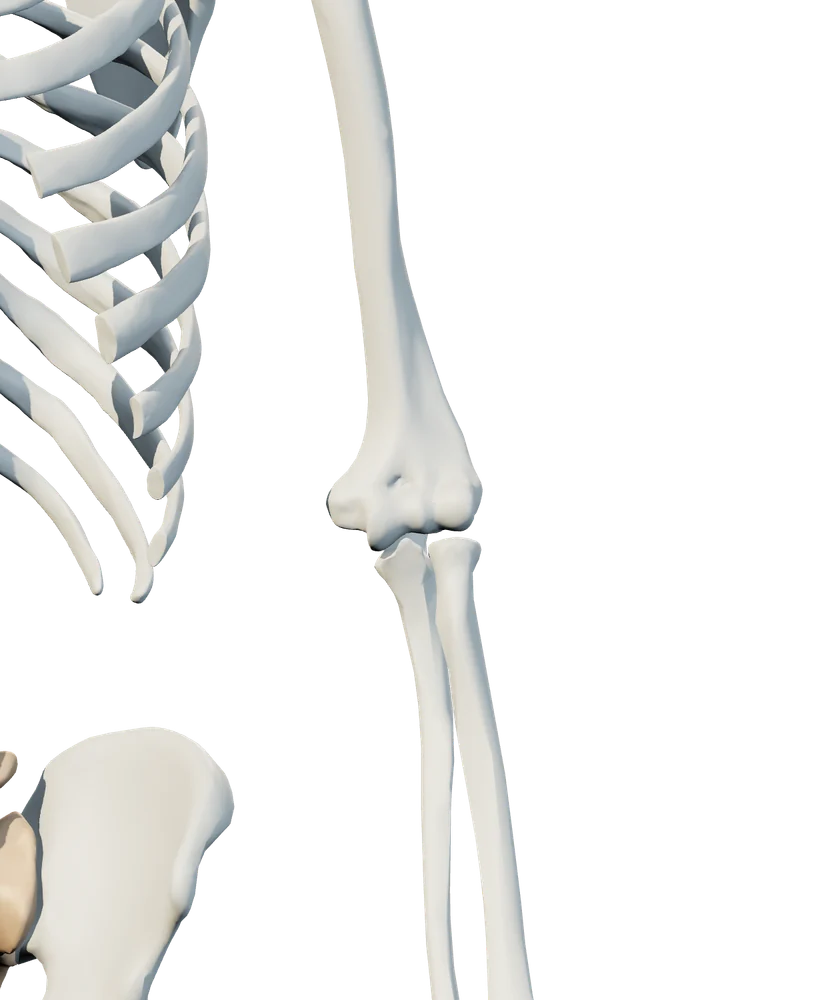
A useful starting point
What this area can tell you.
This pattern can fit lateral elbow tendinopathy, often called tennis elbow, even in someone who does not play tennis. It is still a possibility to assess rather than a diagnosis from location. Local tenderness, changes in workload and the effect of gripping provide context. Numbness, symptoms that travel from the neck or a traumatic onset may point toward a different examination. Useful goals include comfortable carrying and gradually regaining the tasks that matter to you.
Notice the pattern
Three questions to bring with you.
You don’t need to work out a diagnosis before a visit. These details can help you describe what you’re experiencing.
- Which grip or lifting task reproduces the familiar pain most reliably?
- Did work, training or tool use change before symptoms began?
- Is this local pain, or are numbness and symptoms elsewhere in the arm also present?
When to get help sooner
An elbow that is deformed or difficult to move after injury, or hot and swollen with fever, needs urgent assessment. New or worsening hand weakness should be medically assessed promptly.
Follow the connection
Possible explanations. Better questions.
These guides explore conditions or patterns that may overlap with this area. They are starting points for a conversation, not a list of diagnoses that can be confirmed from a body map.
Elbow tendinopathy
Pain with gripping or lifting, often called tennis elbow, and the evidence around treatment choices.
Read the guide Condition guideArm & leg pain
Local joint and muscle symptoms versus pain traveling along a nerve.
Read the guide Condition guideWork-related pain
How job demands, an injury history and a practical return-to-activity plan fit together.
Read the guideRead the result with its limits
How the research fits this area.
The trial studied persistent lateral elbow pain. Steroid injection had worse one-year outcomes than placebo, and physiotherapy showed no significant one-year advantage. It does not support a guaranteed treatment or rapid cure.
How we select and explain sources ↗Follow the evidence
Research, with context.
Published sources behind the discussion. Read the findings alongside the limits; a study is not a diagnosis or a promise of a result.
Effect of corticosteroid injection, physiotherapy, or both on clinical outcomes in patients with unilateral lateral epicondylalgia: a randomized controlled trial
165 adults with lateral elbow pain lasting more than six weeks.
What it foundSteroid recipients had lower recovery and more recurrence at one year than placebo recipients. Physiotherapy did not significantly change one-year recovery or recurrence.
What it cannot tell usResults concern the studied approaches to persistent lateral elbow pain. They do not establish that chiropractic care is superior.
Publication details & citation
Coombes et al. Effect of corticosteroid injection, physiotherapy, or both on clinical outcomes in patients with unilateral lateral epicondylalgia: a randomized controlled trial. JAMA. 2013. DOI: 10.1001/jama.2013.129.
Read the publication record
Read our editorial policy for how sources and clinical review are identified.
Your next step
Bring your questions.
We’ll start there.
An assessment can help clarify the pattern, discuss suitable care, and identify when another clinician should be involved.
Anatomy: BodyParts3D, © DBCLS, CC BY 4.0. Model & rendering credits. Return to the full body explorer.