Benefits of spinal decompression in Clarksville, and who it's for
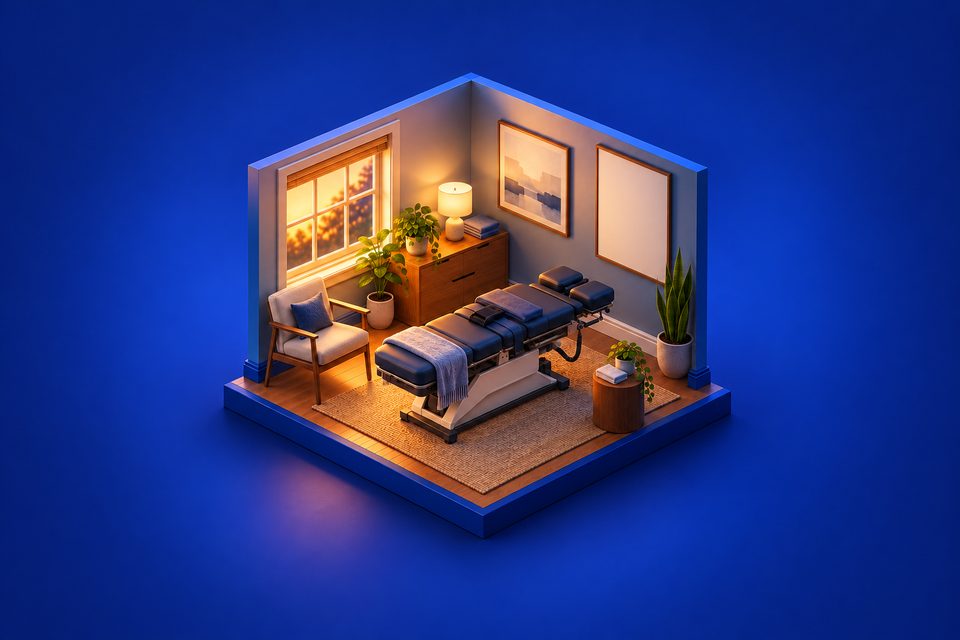
Spinal decompression is a non-surgical, table-based therapy for disc problems in the low back and neck. At Source Chiropractic in Clarksville we use it on the DOC Decompression Table for findings such as herniated and bulging discs and degenerative disc disease, and, in the low back, the sciatica or pinched nerve they can cause. A session lasts 25 minutes lying on the table, and Dr. Jeff Morrey says patients usually fall asleep during it.
The benefit the trials looked at is easing pain and disability in people whose leg or arm symptoms came from an irritated nerve root, which a disc can cause. This article goes through what those trials found, who decompression suits and who it doesn't, and the questions worth asking before you start. For what a session at our office is like and how often it's done, see our spinal decompression page, and when you're ready, book online.
What is spinal decompression?
Spinal decompression applies a controlled, gentle pulling force to the spine, which is why research calls it traction. There are no incisions and no injections.
For the low back, you lie face up on the table with two straps positioned around your waist and chest, and what Dr. Jeff Morrey describes as a gentle stretch is applied to your low back. For the neck, Dr. Cindy Morrey describes the setup this way: your head and neck are fitted into a cradle that supports a gentle decompressive pull to a targeted area of the neck.
The name causes some confusion. Decompression surgery, such as a discectomy or laminectomy, is an operation a spine surgeon performs to take pressure off a nerve. Non-surgical decompression on a table is a different treatment, and it's the one this article is about.
How can a disc cause leg or arm pain?
The discs between your vertebrae have a tough outer ring and a softer center. A bulging disc spreads broadly past its normal edge. A herniated disc is one where disc material has pushed out through the outer ring. They are different findings, and either one may press on a nerve root.
In the low back, pain can then travel into the buttock and leg, sometimes with pins and needles or numbness, which is the pattern most people call sciatica. In the neck, when a nerve root is irritated or compressed, pain can spread into the shoulder or arm, sometimes with tingling, numbness or weakness. Our disc injury, bulging discs and arm and leg pain pages go into more detail.
A scan finding doesn't, on its own, show what's causing your pain. Bulges and herniations turn up on scans of people with no back pain at all, which is why we read imaging alongside the exam rather than on its own.
What are the benefits of spinal decompression?
The trials that found a benefit measured what people feel and can do: pain, and disability, meaning how much the pain gets in the way of everyday life. They studied people whose pain came from an irritated nerve root, and in each one decompression was added to other care rather than used alone:
- Leg pain from a herniated disc. A 2025 trial of 424 hospital patients whose leg pain hadn't settled added lumbar traction to medical treatment that included epidural injections. At one month, 62% of the traction group had at least a 25% improvement in leg pain, against 51% with medical treatment alone. At three months the gap in leg pain (63% against 54%) was no longer statistically significant, and low back pain didn't differ significantly between the groups at either point.
- Decompression added to physical therapy. A 2022 trial of 60 people with leg pain from the low back found that adding non-surgical decompression to physical therapy improved pain and disability more at four weeks than physical therapy alone.
- Lying face up, as on our table. A 2021 review found that traction given lying face up and added to physical therapy reduced pain and disability for up to three months in people with leg pain from a nerve root, in lower-quality studies. In the higher-quality studies, traction given lying face down showed no significant effect.
- Arm symptoms from the neck. In a trial of 86 people, adding mechanical traction to exercise was followed by lower neck disability at six and twelve months than exercise alone, with the twelve-month difference the less certain of the two.
Most of these trials are small or unblinded, so they describe the therapy rather than predict your own result.
Does spinal decompression work?
For leg or arm pain from an irritated nerve root, the trials above found a benefit when decompression was added to other care. Not every trial agrees. In one of 120 people with leg pain from a compressed nerve root, adding traction to an exercise program made no extra difference at any point up to a year, though both groups improved. A Cochrane review of traction for low back pain, with or without sciatica, found little or no difference, with studies searched through 2012, and England's NICE guideline recommends against offering traction for low back pain, with or without sciatica.
So the research that supports decompression is about leg or arm pain from an irritated nerve root, not back pain in general.
Who is spinal decompression for?
We use decompression on the lower back (lumbar) and on the neck (cervical), for disc-related findings such as:
- Herniated discs
- Bulging discs
- Degenerative disc disease
- Sciatica
- Pinched nerve
In the neck, we may use it for disc degeneration and for herniated or bulging discs, and our neck pain guide covers where neck pain can start. Your exam tells us whether decompression fits your problem.
That decision starts at your first visit. You'll sit down with Dr. Jeff, Dr. Cindy or Dr. Ali and go over your health history, your symptoms, your concerns and your goals, then have a full evaluation, with full-spine X-rays when they're clinically appropriate. You'll hear what we found before we recommend anything.
Decompression can be one treatment among several. For leg pain, a plan may include decompression alongside adjustments, rehab exercises, class IV laser therapy and dry needling, depending on what we find. Decompression is usually done 2 to 3 times a week, and how many sessions you'd need is set after the exam, based on your condition and goals.
Who shouldn't have spinal decompression?
We don't put you on the decompression table if you're pregnant, if you've had a spinal fusion or have hardware in your spine, if you have osteoporosis, or if you have a recent fracture. The same goes for neck decompression. Beyond those, we go through your paperwork for any reason treatment may not be a good idea, and we want to hear about new symptoms, past surgery, injuries and medical conditions before a first session. If decompression doesn't suit you, we'll go through the other options with you.
Is spinal decompression safe?
Decompression is non-surgical, but it has side effects in some people. A Cochrane review found that seven of 32 traction trials reported adverse effects, including more pain, worsening nerve symptoms and later surgery. In the 2025 hospital trial, 7 of 211 people in the traction group reported side effects, against 2 of 213 with medical treatment alone, a difference that wasn't statistically significant. Three people in the traction group developed new weakness: one was treated with surgery, one recovered on its own, and one still had mild weakness when the trial reported. One person in the medical-treatment group also developed new weakness. Tell us right away about any pain, numbness or weakness that's getting worse during care.
What are the alternatives to spinal decompression?
Other options for disc and back pain include guided exercise, which a Cochrane review found probably improves chronic low back pain, physical therapy, medical treatment including epidural injections, and a medical or surgical opinion for some disc problems. If it isn't a muscle-and-joint problem, we'll tell you and refer you for the right medical evaluation.
Questions to ask before you start spinal decompression
These are good questions to bring to your first visit, and here's how we answer them:
| Question | Our answer |
|---|---|
| What problem are we treating? | What your exam finds, which we go through with you at the first visit. |
| How will we review progress? | We re-evaluate the plan every 6 visits. |
| What will a course cost? | It depends on the plan, which is set after the exam, so ask for the total before you commit to more sessions. We accept HSA and FSA accounts, and superbills can be provided to any patient who wants to file with their insurer. |
When is back, neck, arm or leg pain an emergency?
Most disc problems aren't emergencies, but some signs are.
Call 911 now for either of these:
- Arm pain with chest pain, heaviness or discomfort, shortness of breath, or sweating for no reason. The National Heart, Lung, and Blood Institute's list of heart attack symptoms includes pain or discomfort in one or both arms, the back, shoulders, neck or jaw, alongside chest pain, the most common one.
- Sudden numbness or weakness of the face, arm or leg, especially on one side of the body, or sudden confusion, trouble speaking, trouble seeing or trouble walking. These are stroke symptoms, and every minute counts.
Warning signs that start with neck pain and headache are on our neck pain page.
If you have any of these with back or leg pain, go to an emergency room now, not to an appointment with us or a decompression session:
- Loss of bladder or bowel control, or new difficulty passing urine
- A change in the sensation of passing urine, such as not feeling the flow, or losing the sense of when the bowel is full
- Numbness in the saddle area: the inner thighs, buttocks, or around the genitals
- New sexual dysfunction, including new numbness in the genitals
- New or worsening weakness in both legs
- Severe back pain with fever, or an unexplained fever with new back pain. Either alone is enough
Changes in the bladder or bowel, a change in feeling in the saddle area, or weakness in both legs can be signs of cauda equina syndrome, an emergency involving the nerves at the bottom of the spinal canal. The NHS also lists sciatica on both sides among its emergency signs.
Leg pain isn't always a disc. Get urgent medical care, not decompression, for signs of a blood clot in the leg:
- A calf or leg that is swollen, warm, red or tender, especially in one leg only
- Sudden shortness of breath or chest pain, which can mean a clot has moved to the lungs. Call 911
Getting spinal decompression in Clarksville
If a disc problem is sending pain into your leg or arm and none of the warning signs above fit, a first visit is where we find out whether decompression belongs in your plan. Our spinal decompression page covers what a session is like, how often it's done, and insurance and payment, and it's the place to book. For back pain more broadly, see our back pain page.
The new-patient chiropractic offer has its own terms.
If we are not able to help you with your problem or are unable to reduce your pain levels, we will make sure to give you a recommendation to another experienced provider. Book online or contact us.
Explore the lower back to compare disc injury, sciatica and back pain.
Research, with context.
Selected published sources behind what we've written, each with what it found and what it can't tell us. We give you both halves because no paper can diagnose you or predict how your own care will go.
Lumbar Tractions in Radicular Pain Caused by Herniated Disc: Randomised, Open-Label, Superiority, and Controlled Trial on 424 Participants
424 patients at a hospital rheumatology unit with leg pain from a herniated disc that had not settled with outpatient treatment; all received medical treatment including at least two epidural injections, and half also received lumbar traction.
What it foundAt one month, 62% of the traction group and 51% of the medical-treatment group had at least a 25% improvement in leg pain (388 of the 424 were analysed). At three months the leg-pain difference (63% against 54%) was not statistically significant, and back pain improved in the same share of both groups (51%) at one month.
What it can't tell usNobody was blinded, the main result was measured at one month, and the patients were hospital referrals already having injections, so it doesn't show what traction does on its own or for milder leg pain.
Publication details & citation
Bernhard et al. Lumbar Tractions in Radicular Pain Caused by Herniated Disc: Randomised, Open-Label, Superiority, and Controlled Trial on 424 Participants. Journal of Clinical Medicine. 2025. DOI: 10.3390/jcm14155192.
Read the publication recordEffects of non-surgical decompression therapy in addition to routine physical therapy on pain, range of motion, endurance, functional disability and quality of life versus routine physical therapy alone in patients with lumbar radiculopathy; a randomized controlled trial
60 people with lumbar radiculopathy, all given routine physical therapy, half also given non-surgical decompression on a computerized table, 12 sessions over four weeks.
What it foundThe decompression group improved more in pain, disability, back range of motion, back muscle endurance and two quality-of-life measures at four weeks.
What it can't tell usIt was one small trial with no sham treatment, and its outcomes were reported at the end of the four weeks of treatment, so it can't say how long any difference lasts.
Publication details & citation
Amjad et al. Effects of non-surgical decompression therapy in addition to routine physical therapy on pain, range of motion, endurance, functional disability and quality of life versus routine physical therapy alone in patients with lumbar radiculopathy; a randomized controlled trial. BMC Musculoskeletal Disorders. 2022. DOI: 10.1186/s12891-022-05196-x.
Read the publication recordEffectiveness of Mechanical Traction for Lumbar Radiculopathy: A Systematic Review and Meta-Analysis
Eight randomized trials in adults with lumbar radiculopathy (leg pain from an irritated nerve root), five of them pooled.
What it foundTraction given lying face up and added to physical therapy reduced pain and disability in the short term, up to three months. Traction given lying face down showed no significant effect in the higher-quality studies.
What it can't tell usThe face-up result came from low-quality studies, and it reaches only three months. It's evidence about traction added to physical therapy, not traction on its own.
Publication details & citation
Vanti et al. Effectiveness of Mechanical Traction for Lumbar Radiculopathy: A Systematic Review and Meta-Analysis. Physical Therapy. 2021. DOI: 10.1093/ptj/pzaa231.
Read the publication recordExercise only, exercise with mechanical traction, or exercise with over-door traction for patients with cervical radiculopathy, with or without consideration of status on a previously described subgrouping rule: a randomized clinical trial
86 people with neck pain and signs of cervical radiculopathy (arm symptoms from a neck nerve root), given four weeks of exercise alone, exercise with mechanical traction, or exercise with over-door traction.
What it foundAdding mechanical traction to exercise was followed by lower neck disability at six and twelve months than exercise alone, and lower than over-door traction at six months.
What it can't tell usIt's a single trial of 86 people with arm symptoms from the neck, and the twelve-month difference was less certain than the six-month one. It doesn't speak for neck pain without arm symptoms, or for traction without exercise.
Publication details & citation
Fritz et al. Exercise only, exercise with mechanical traction, or exercise with over-door traction for patients with cervical radiculopathy, with or without consideration of status on a previously described subgrouping rule: a randomized clinical trial. Journal of Orthopaedic & Sports Physical Therapy. 2014. DOI: 10.2519/jospt.2014.5065.
Read the publication recordThe Effectiveness of Mechanical Traction Among Subgroups of Patients With Low Back Pain and Leg Pain: A Randomized Trial
120 people with low-back pain and signs of lumbar nerve root compression, treated with extension-oriented exercise with or without mechanical traction, up to 12 visits over six weeks.
What it foundBoth groups improved, and adding traction made no difference to pain or disability at six weeks, six months or one year, including in the subgroup expected to respond.
What it can't tell usIt tested traction added to one exercise approach in physical therapy clinics, so it doesn't show how traction compares with no treatment at all.
Publication details & citation
Thackeray et al. The Effectiveness of Mechanical Traction Among Subgroups of Patients With Low Back Pain and Leg Pain: A Randomized Trial. Journal of Orthopaedic & Sports Physical Therapy. 2016. DOI: 10.2519/jospt.2016.6238.
Read the publication recordTraction for low-back pain with or without sciatica
32 randomized trials involving 2,762 people with low-back pain, with or without sciatica, using manual or machine traction.
What it foundTraction, alone or added to other treatment, made little or no difference to pain, function or overall improvement. Seven trials reported adverse effects, including increased pain, worsening nerve signs and later surgery.
What it can't tell usThe evidence was searched through 2012, the trials were small and many had moderate to high risk of bias, and the review didn't test any one branded table.
Publication details & citation
Wegner et al. Traction for low-back pain with or without sciatica. Cochrane Database of Systematic Reviews. 2013. DOI: 10.1002/14651858.CD003010.pub5.
Read the publication recordExercise therapy for chronic low back pain
249 trials of exercise therapy in adults with chronic nonspecific low-back pain.
What it foundExercise probably improves pain compared with no treatment, usual care or placebo. Average improvements in function were smaller.
What it can't tell usThe programs, and what they were compared with, varied. The review doesn't point to one best exercise for everyone, and it doesn't apply to a new fracture, an infection or a neurological problem that's getting worse.
Publication details & citation
Hayden et al. Exercise therapy for chronic low back pain. Cochrane Database of Systematic Reviews. 2021. DOI: 10.1002/14651858.CD009790.pub2.
Read the publication record
Our editorial policy explains how to read these sources and what our clinical-review labels mean.