03 / Understand the area
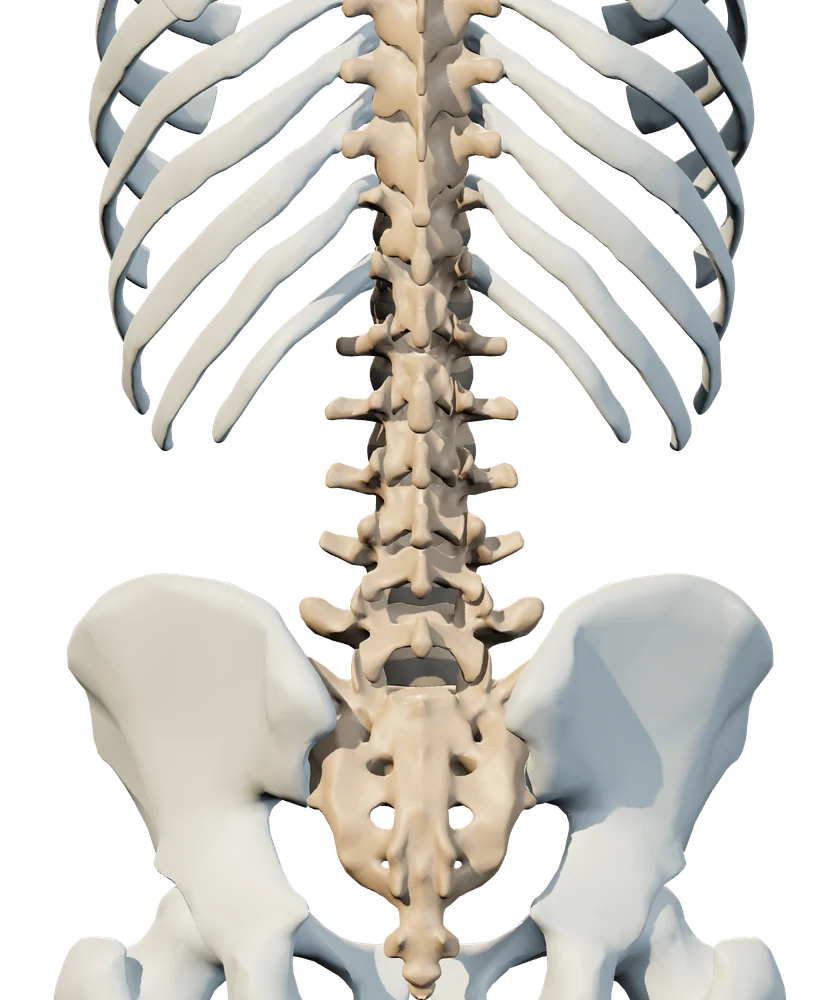
Center of the lower back
Pain in the center of the lower back does not, by itself, identify a disc problem or mean your spine is damaged.
An educational guide for either side of the body. Location alone cannot tell us the cause of a symptom.
A useful starting point
What this area can tell you.
Many low-back episodes are assessed through symptoms, everyday function and an examination before a precise structure can be named. A scan may show age-related changes that also occur in people without pain, so its relevance depends on the clinical picture. Tell your clinician whether symptoms stay central, spread to a leg or are changing quickly. Agree on practical goals such as sitting through a meal, walking farther or returning to a particular task, and how progress will be reviewed.
Notice the pattern
Three questions to bring with you.
You don’t need to work out a diagnosis before a visit. These details can help you describe what you’re experiencing.
- Does the pain stay in the back, or has it started traveling into a buttock or leg?
- Which activity is most limited: sitting, bending, walking or getting out of a chair?
- Is your overall ability to move improving, staying the same or getting worse?
When to get help sooner
New bladder or bowel changes, numbness around the genitals or anus, or weakness in both legs needs emergency care. Back pain with fever, significant injury or rapidly worsening symptoms needs urgent assessment.
Follow the connection
Possible explanations. Better questions.
These guides explore conditions or patterns that may overlap with this area. They are starting points for a conversation, not a list of diagnoses that can be confirmed from a body map.
Back pain
Common back-pain patterns, warning signs and how to judge progress in everyday life.
Read the guide Condition guideDisc injury
Disc changes, symptoms and treatment choices without assuming every scan finding explains pain.
Read the guide Condition guideSciatica
Leg pain related to nerve irritation, what scans can and cannot tell you, and when to seek help.
Read the guideRead the result with its limits
How the research fits this area.
The guideline discusses non-drug options for adult low-back pain, with varying evidence quality. The imaging review shows why scan findings need clinical context; it does not mean every scan or finding can be dismissed.
How we select and explain sources ↗Follow the evidence
Research, with context.
Published sources behind the discussion. Read the findings alongside the limits; a study is not a diagnosis or a promise of a result.
Noninvasive Treatments for Acute, Subacute, and Chronic Low Back Pain: A Clinical Practice Guideline From the American College of Physicians
Adults with acute, subacute or chronic low-back pain considering noninvasive management.
What it foundThe guideline prioritizes non-drug options for chronic low-back pain, including exercise. Spinal manipulation is one of several options, supported by lower-quality evidence.
What it cannot tell usA guideline synthesizes evidence rather than reporting a new experiment. It does not establish disc realignment, a universal cure or superiority over all other care.
Publication details & citation
Qaseem et al. Noninvasive Treatments for Acute, Subacute, and Chronic Low Back Pain: A Clinical Practice Guideline From the American College of Physicians. Annals of Internal Medicine. 2017. DOI: 10.7326/M16-2367.
Read the publication recordSystematic literature review of imaging features of spinal degeneration in asymptomatic populations
33 studies reporting imaging findings in 3,110 people without symptoms.
What it foundDegenerative findings were common in people without pain and became more frequent with age. A scan needs interpretation alongside symptoms and examination findings.
What it cannot tell usThis does not mean every disc finding is harmless or that imaging is never needed. It cannot identify the cause of an individual patient’s pain.
Publication details & citation
Brinjikji et al. Systematic literature review of imaging features of spinal degeneration in asymptomatic populations. American Journal of Neuroradiology. 2015. DOI: 10.3174/ajnr.A4173.
Read the publication record
Read our editorial policy for how sources and clinical review are identified.
Your next step
Bring your questions.
We’ll start there.
An assessment can help clarify the pattern, discuss suitable care, and identify when another clinician should be involved.
Anatomy: BodyParts3D, © DBCLS, CC BY 4.0. Model & rendering credits. Return to the full body explorer.