What is cold laser therapy?
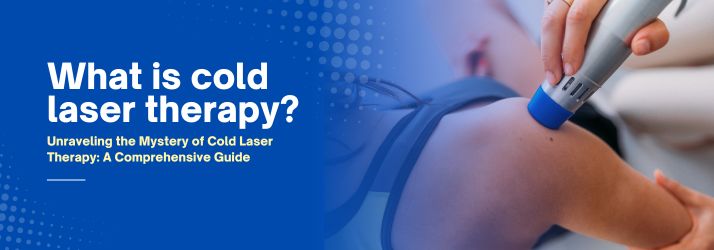
Cold laser therapy is the everyday name for low-level laser therapy: light aimed at tissue as a treatment, with no incision. It's also called photobiomodulation. Device and dose matter, so research on one laser treatment doesn't describe every laser or red-light product.
Does cold laser therapy work?
It depends on the condition and the treatment studied. For chronic low-back pain, NCCIH describes some favorable results but notes limited research and low-quality evidence behind a guideline recommendation. With evidence that limited, nobody can promise low-level laser will work for your back.
The idea that the light acts on cells is a proposed explanation, and a long way from knowing how your own back will respond. That gap is why a plan with laser in it needs a clear goal and a point to reassess.
How is cold laser different from the Class IV laser we use?
At our Clarksville office we use the Summus Horizon, a Class IV medical laser. "Class IV" rates the beam's hazard, not what it's used for or how well it works. Our laser and LED light therapy page covers the device and how we use it.
Summus describes the Horizon's intended use as local heating for temporary comfort in minor muscle or joint complaints, plus temporary local circulation and relaxation effects. That's a narrower job than repairing tissue or reversing disease.
We don't use laser for diabetic neuropathy, wounds or burns, trigeminal neuralgia or cosmetic skin concerns.
What are the risks of laser therapy, and the alternatives?
No incision doesn't mean no risk. Class IV beams can injure eyes or skin, including through reflected light. That's why protective eyewear, operator training and precautions specific to you matter, and you can ask us about any of them.
For low-back pain, NICE gives exercise and staying active a place in care and considers manual therapy within an exercise-based plan. Depending on the cause, medical care from your doctor or physical therapy may be the better route. We'll tell you what we find, including when it's not something we treat.
What to know before laser therapy is part of any plan
Any plan, laser included, comes after we've examined you and gone over what we found. If laser goes into your plan, it'll be because of something the exam found, and we'll go over that with you. Going in, it helps to know what change would make it worth continuing, and what happens if your symptoms get worse or don't budge. The office can tell you what a visit costs when you call.
Our laser research notes cover what selected trials found and where they stop short of any one device or treatment plan. If a sore back or shoulder has you wondering about laser, give us a call and we'll talk it through. New to us? Here's our new-patient offer and its terms.
Follow the evidence
Research, with context.
Selected published sources behind what we've written, each with what it found and what it can't tell us. We give you both halves because no paper can diagnose you or predict how your own care will go.
Photobiomodulation therapy is not better than placebo in patients with chronic nonspecific low back pain: a randomised placebo-controlled trial
148 adults with chronic nonspecific low-back pain, receiving 12 active or placebo sessions over four weeks; both groups received education.
What it foundThere was no clinically important difference in the primary pain and disability outcomes at four weeks.
What it can't tell usPatients, therapists and assessors were all blinded. It tested one protocol, so it doesn't show that every laser device performs the same, and it gives no support to claims that light regenerates a disc.
Publication details & citation
Guimarães et al. Photobiomodulation therapy is not better than placebo in patients with chronic nonspecific low back pain: a randomised placebo-controlled trial. Pain. 2021. DOI: 10.1097/j.pain.0000000000002189.
Read the publication recordThe effects of photobiomodulation and transcutaneous electrical nerve stimulation on chronic neck pain: A double-blind, randomized, sham-controlled trial
144 people with chronic neck pain, assigned photobiomodulation, electrical stimulation, both, or sham treatment for ten sessions over two weeks.
What it foundThe groups did not differ in the primary outcome of pain at rest. Some secondary outcomes favored the combined treatment.
What it can't tell usThe secondary findings came from light and electrical stimulation combined, so they can't tell us what light therapy alone does. The treatment period was also short.
Publication details & citation
Rampazo et al. The effects of photobiomodulation and transcutaneous electrical nerve stimulation on chronic neck pain: A double-blind, randomized, sham-controlled trial. Brazilian Journal of Physical Therapy. 2024. DOI: 10.1016/j.bjpt.2024.101124.
Read the publication record
Our editorial policy explains how to read these sources and what our clinical-review labels mean.